Quick Answer
“Plugged in, not charging” on a Lenovo Chromebook almost always means the charger can’t keep up with current power draw, common on entry-level Duet and Flex models bundled with lower-wattage chargers. Close demanding apps, confirm your charger’s wattage, and let the device idle to see if charging resumes.
Causes
This message appears on Lenovo Chromebooks most often because a bundled low-wattage charger can’t supply enough power during active use, because a loose USB-C connection isn’t delivering full power, because a non-Lenovo charger fails to negotiate power delivery correctly, or because the battery is nearly full and the system is intentionally trickle-maintaining it.
Fix Steps
Step 1: Close demanding apps
Video calls and multiple heavy tabs can draw more power than a lower-wattage Lenovo charger supplies. Close what you don’t need and check if charging resumes.
Step 2: Confirm your charger’s wattage
Lenovo’s budget Chromebook lines (Duet, Flex 3) often ship with smaller chargers than premium models. Check the label and compare it against our charger wattage guide.
Step 3: Use the original Lenovo charger if possible
Third-party chargers sometimes fail to negotiate the correct power profile even when the wattage looks sufficient on paper. Lenovo’s own charger is the safest first test.
Step 4: Reseat the cable at both ends
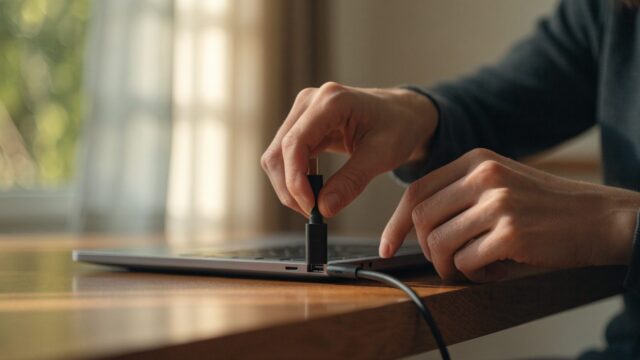
Unplug and firmly reconnect the cable at the wall adapter and the Chromebook, since a loose connection can cause the system to detect power without charging reliably.
Step 5: Let it idle
Put the device to sleep or turn it off while plugged in. If charging resumes once idle, the charger was simply outpaced by active usage rather than failing outright.
Step 6: Restart to clear a stale reading
Sometimes the “not charging” message is a stuck software reading rather than an actual failure, and a restart clears it immediately.
Still Not Fixed?
If a known-good, correctly-rated charger still won’t charge the device while idle, work through our full charging diagnostic guide, which covers port damage and battery failure. If the Chromebook is also running slow, address that separately, since it’s usually unrelated to charging.
FAQ
Why does this happen more on Lenovo’s budget models?
Duet and Flex series Chromebooks often ship with lower-wattage chargers to keep costs down, which makes them more likely to hit this message during heavier use than premium models with higher-wattage chargers.
Should I buy a higher-wattage charger for my Lenovo Chromebook?
If this happens often during normal use, yes. A charger rated at or above your model’s original spec resolves it in most cases.
Is it safe to keep using the Chromebook while it shows this message?
Yes, it just means the device is running on wall power directly rather than topping up the battery, which isn’t harmful to use.